
Tools
Any moment. Any room. Any phone.
Peace Labs prepares an outreach team for the moments they will actually face, before they face them. It gives a classroom real-life scenarios to work through together, and the words to use when it counts. It shows a program what a room chose, week by week. Here is how.
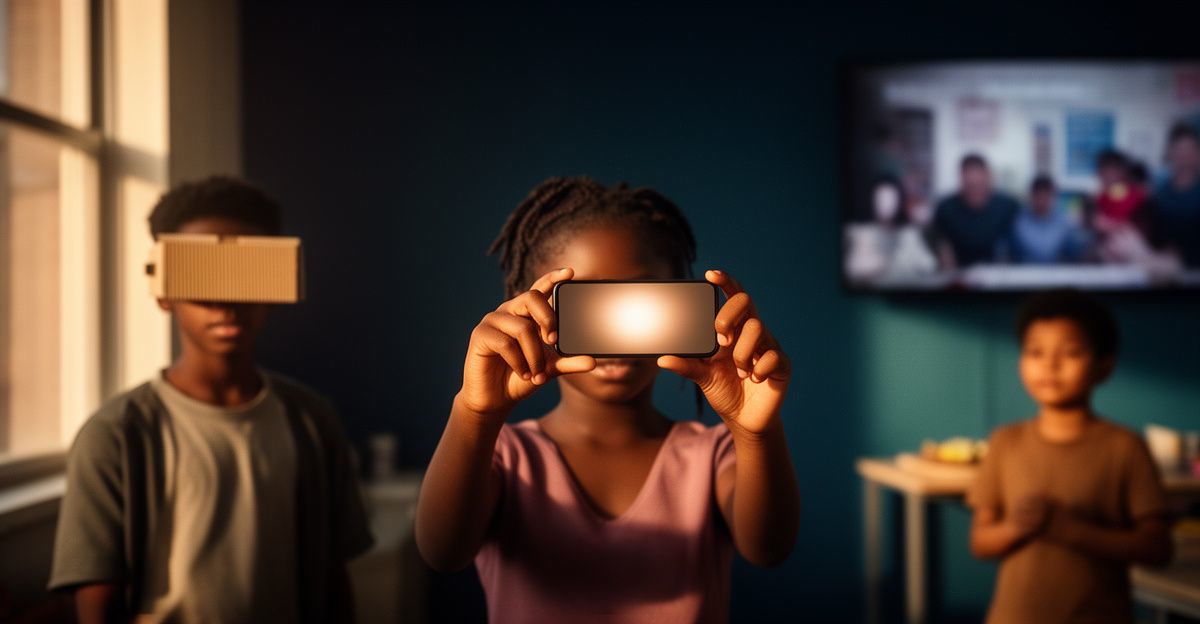
Peace Labs runs in a browser, on a phone or in a headset. Nothing to install.
Any moment becomes a scenario
Your corners, your hallways, your language, in days.
The value: Peace Labs builds the scenarios your people actually face, in the places they know, without a production budget. A program is never stuck with someone else's scene.
The tech: a scenario is data. The cast, the place, what each person knows and when they may say it, what sets them off and what calms them, the pressure (distance, audience, information, support), the turning points and the endings that are earned: one definition per experience, versioned, edited in the admin, published when a person says yes. The intensity is a dial, so the same scenario runs for a middle-school classroom and, at full strength, for the workers who need it that way.
People learners recognize
A whole season with the same faces.
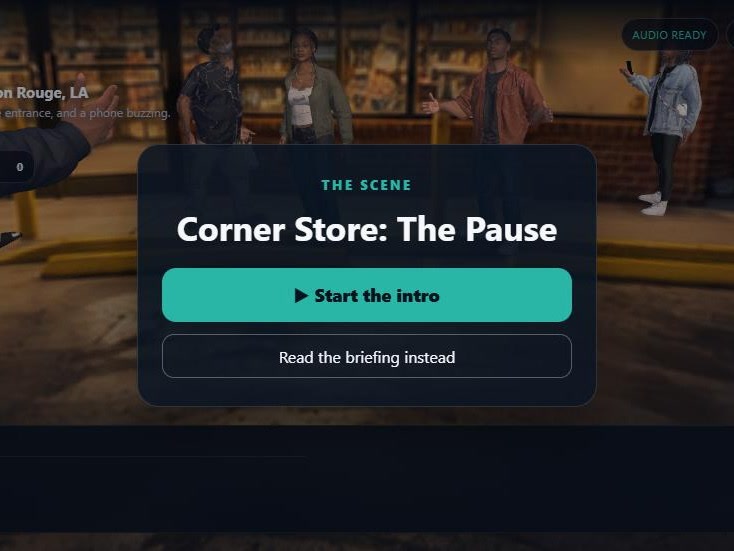
The value: learners meet Malik, Dre and Nia again and again, so the practice builds like a relationship, and a crowd that reacts makes the pressure feel real.
The tech: Peace Labs keeps a character as a record: look, voice, personality, what they know, how they react. Built once, present in every scenario that needs them. Bystanders and passers-by carry profiles too (the one filming, the hype man, the nervous one, the elder, the worker), and their phones and attention change the pressure in the scene.

No script to memorize
Say it your way. They answer in theirs.
The value: a learner practices the words they would actually say, out loud, and hears a real reaction instead of picking a right answer from a list.
The tech: the player speaks or types. Peace Labs reads the intent (calm things down, challenge, side with someone, ask, step in, walk away), decides the consequence by the rules of the scenario, and the characters reply live in natural voice. A character cannot say what they have not learned yet; a turning point is spoken by the right person; a missing line falls back to an approved one.
No film crew, no capture day
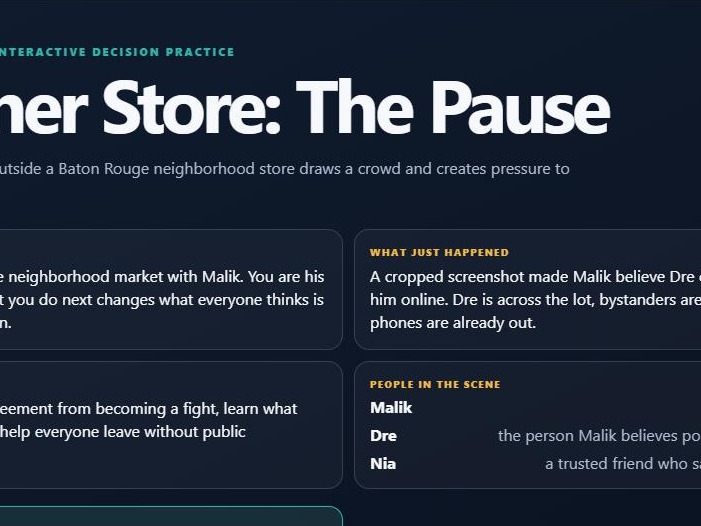
Realistic people and places, made in the Peace Labs studio.
The value: a new scenario costs words and review time, not a shoot. A city of any size can afford its own.
The tech: the Peace Labs studio generates the characters, the places, the motion and the voices from text and reference pictures, previews everything, and nothing reaches a learner until a person approves it. Identical media is never made twice. Every outside provider sits behind an adapter, so a vendor can change without touching a single scenario.
Proof for the people who fund it
See what a room chose, and how that moved.
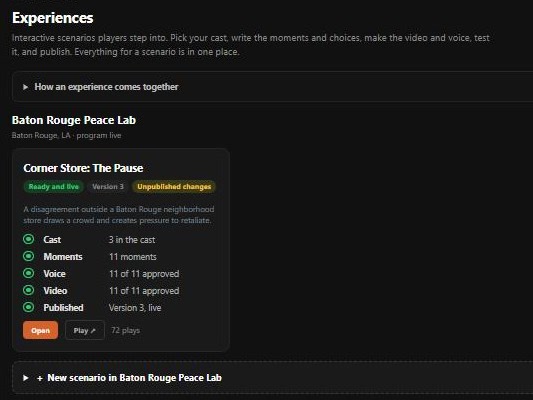
The value: a program shows a funder, a school board or a city council what changed, in numbers a worker can also feel.
The tech: Peace Labs records every session, turn, choice and spoken line (with a visible notice and a storage setting the program controls). A cohort report shows what a room chose and how that moved across weeks; a learner's completions can sit on their record. Shared links with an end date open one scenario for one room and count who came.
More than one front
Peace Labs on the phone, on the wall and on the street
Peace Ambassadors
Every young person, worker, church or team gets a Peace Labs link of their own. Who they bring in is on their record, and a school or a neighborhood can see its own leaderboard.
Know the Signs
Phone-played, wall-hosted trivia that teaches the signs and the moves: what fentanyl does, the four moves, what 988 does. For a youth night, or always on in a center.
Peace Screens
A tablet or a streaming stick becomes a Peace Labs screen in minutes: the next workshop, a sixty-second preview, the 988 card, on the wall of every partner location.
The Peace Line
A text and voice line that listens, walks a person through the four moves, hands off to 988 or 211, and books a facilitator call. Built on a phone system that already answers a business every day.
Also in the platform
Sponsor placements
A local business can be named on a storefront in a scenario or fund a room. Managed per brand, kept out of the sensitive moments.
The workforce record
A completed scenario becomes a de-escalation credential on a person's Community Corp record, where partner employers see it.
Peace Kits
Kits by the door of partner locations, and a map to find the nearest one. Coming.
Request a demo
See Peace Labs running, with your streets in mind
Tell us who you are and Peace Labs sends one email with a link. The link opens the experiences for you, and a person follows up about a walkthrough.
Partners ask
Can my whole team play?
Each person confirms their own email once and the experiences stay open on their browser for 30 days. For a room, a partner can also share one link that opens a single scenario for everyone, with an end date.
What do learners need?
A browser. A phone adds the street view and a cardboard-style headset; a VR headset adds controller play. Nothing to install.
Who builds our experiences?
Peace Labs does, with you: your moments, your places, your language. The engine and the studio are ours; the stories are yours.